
You taught them algebra. Who’s teaching them money?
UPI made spending invisible before it made saving intuitive. Pluto is the course that puts money back in your teen’s hands: the smart way, before the real world does it the hard way.
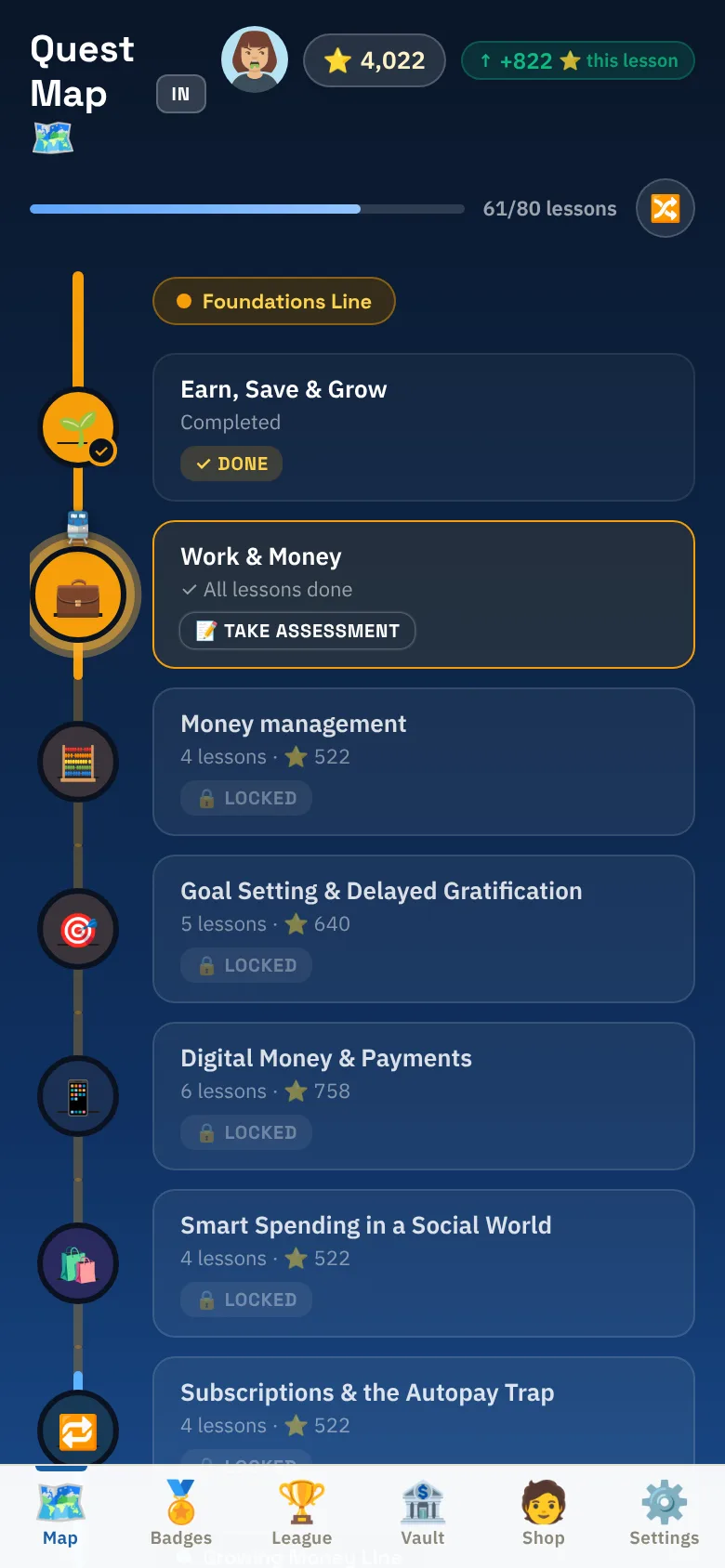
Teenagers get handed real money years before anyone teaches them what to do with it.
A young country, no money class
India has one of the youngest populations on earth, yet personal finance appears almost nowhere in the school curriculum.
UPI in every pocket
UPI and instant credit put real spending power in a teenager’s pocket long before they understand interest, debt, or risk.
No time, no lesson plan
Parents want their kids financially capable, but rarely have the time or the lesson plan to teach it themselves.
Nothing in between
What exists today is either a children’s game with no real substance, or an adult investing app that assumes knowledge no teen has yet.
A practice bank, not a quiz.
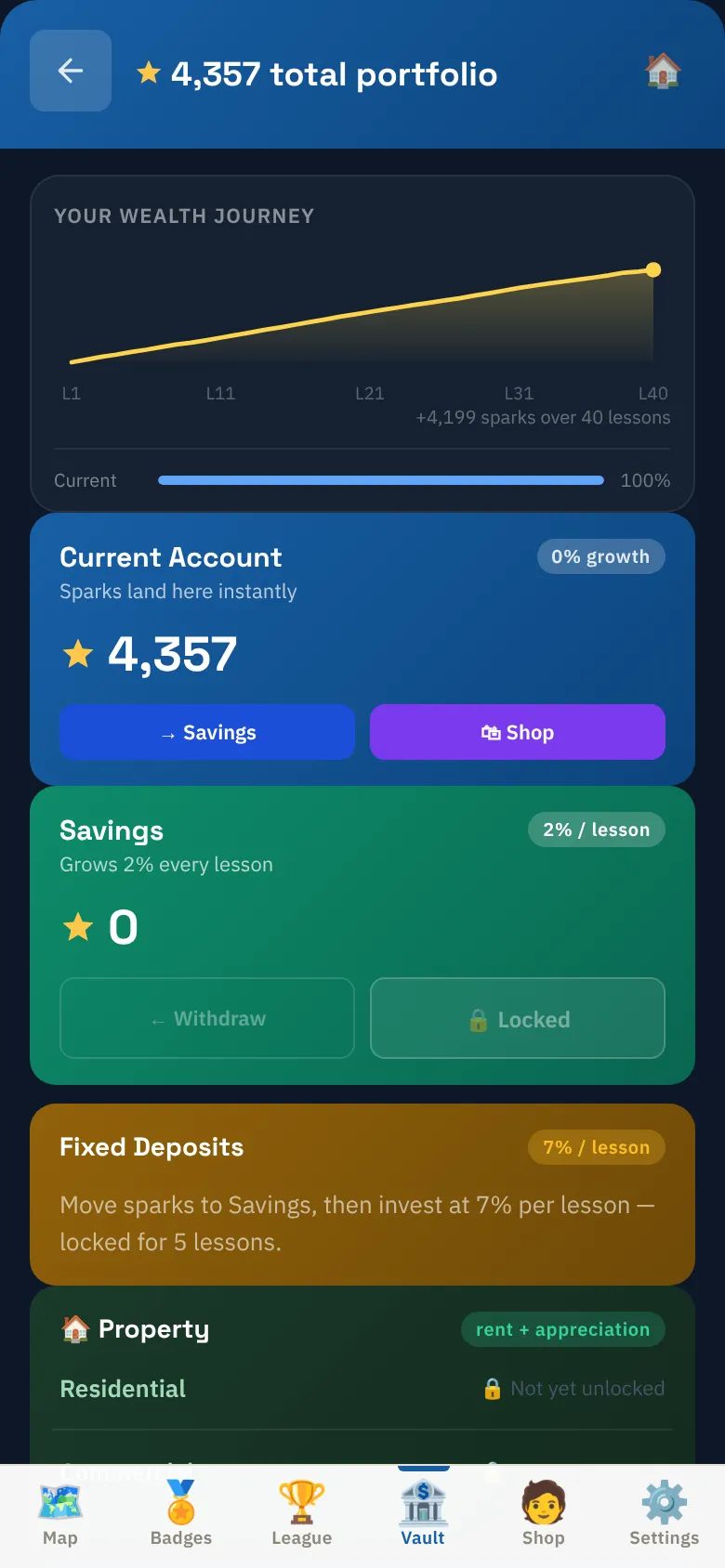
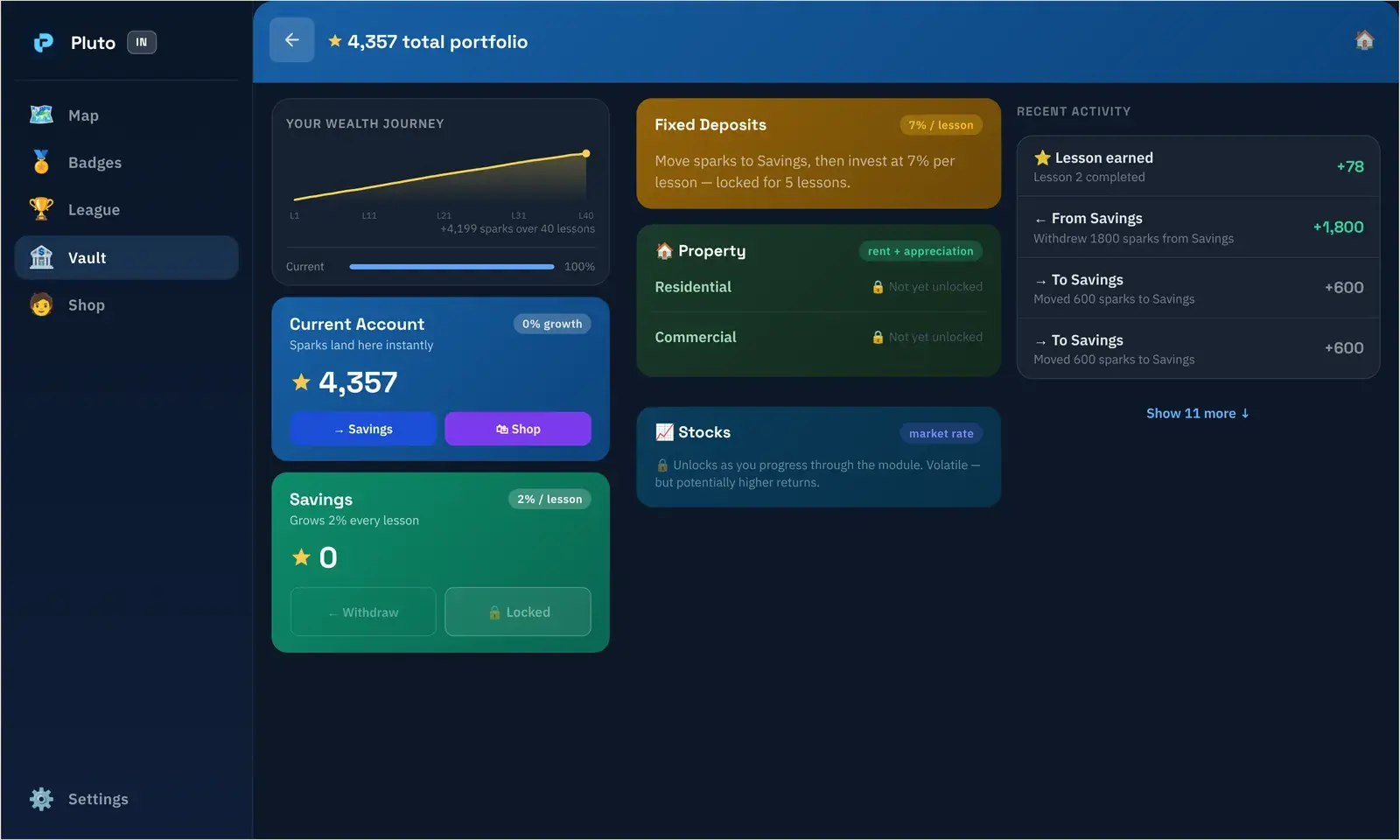
Pluto’s Vault is a real practice bank. Balances grow lesson by lesson at the same rate the lessons teach, and instruments unlock exactly when the relevant lesson completes.
- A live Checking and Savings account that earns interest as your teen learns
- Fixed Deposits, Stocks and Property open up as they are taught: risk versus return, seen firsthand
- A real goal, not just a number: pick something from a Dream List, watch a Savings Jar fill, then “buy” it
- Older learners open a Retirement SIP and watch it compound, and a 300–900 Credit Score that moves with real decisions
Sparky: a mentor who’s always one question away.
Stuck on why compound beats simple interest? Sparky answers in plain language, grounded in the lesson your teen is on.
- Lesson-aware. No generic finance trivia: Sparky knows which lesson your teen is on.
- Built for guided use. A daily question quota keeps it a teaching tool, not a homework shortcut.
- Safe by design. Sparky explains. It never gives personalised investment advice.
12 and 18 don’t need different numbers. They need different modules.
Every tier shares the same ten core modules, plus four more built for what is relevant at that age. Same rigour throughout; the curriculum climbs with the learner.
Liftoff
Ages 12–14
Round numbers and clean ₹ amounts, plus four modules built around the money moments that happen right now: first allowance, first bank account, first UPI transaction.
- Banking Basics
- Family Money & Communication
- Goal Setting & Delayed Gratification
- Digital Money & Payments
Orbit
Ages 15–16
The baseline curriculum at full real-world complexity, plus four modules built for exactly this age, including two found nowhere else in the app.
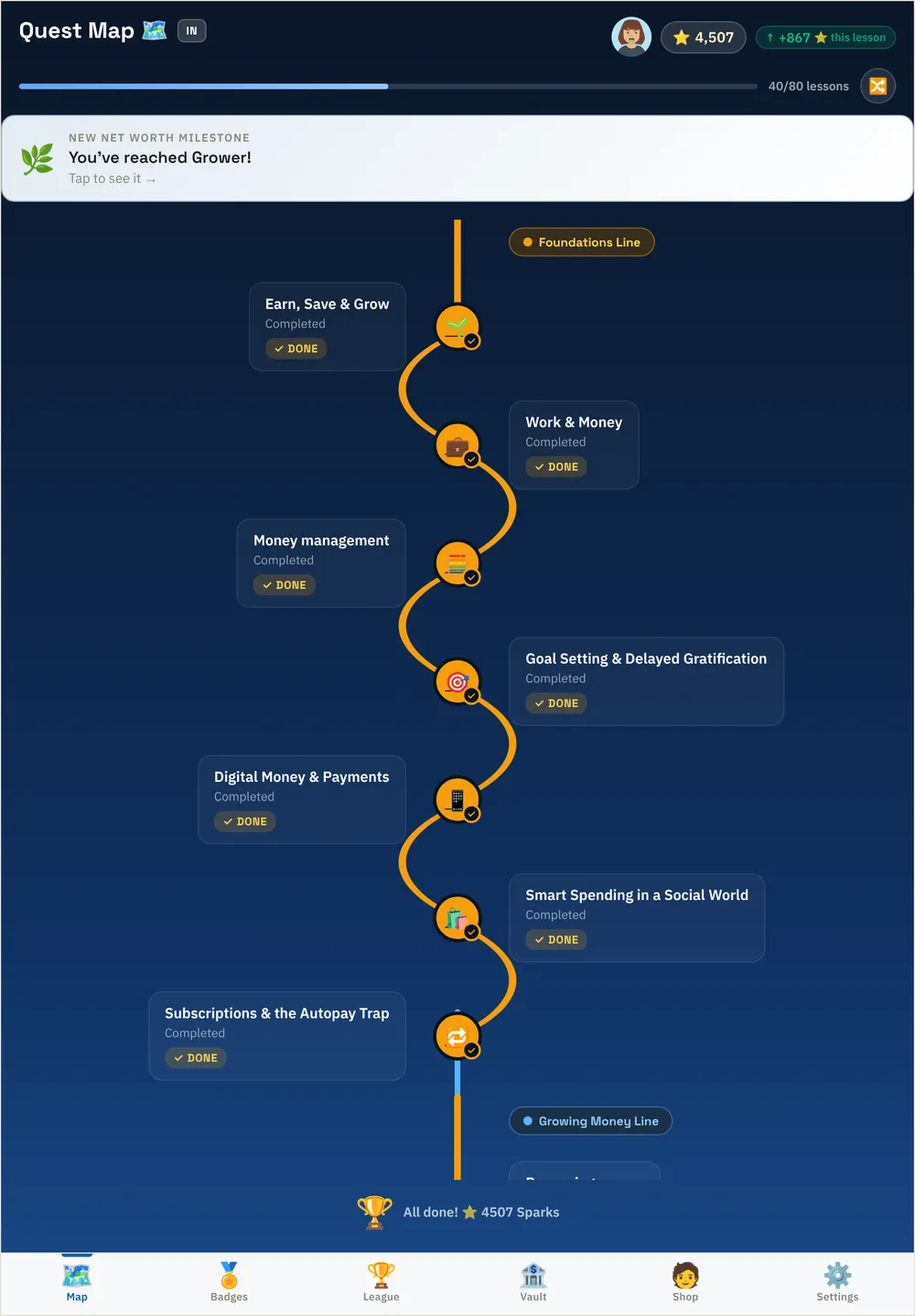
- Goal Setting & Delayed Gratification
- Digital Money & Payments
- Smart Spending in a Social World
- Subscriptions & the Autopay Trap
Escape Velocity
Ages 17+
Same rigour as Orbit, aimed at decisions this age is about to face: a first freelance gig, a first credit card, a first retirement account, a first tax return.
- Gig & Freelance Income
- Credit Score & Real Loans
- Retirement & Long-Term Wealth
- Capital Gains & Filing
Ten modules every learner completes.
From earning and saving through investing, borrowing, entrepreneurship, next-gen currency, and protecting what has been built: one full financial education, not a single-topic app.
Earn, Save & Grow
How money flows in, why saving early matters, simple vs. compound interest, and why idle cash quietly loses value.
7 lessonsWork & Money
Careers, salaries, payslips, and how tax actually works, demystified before it is a real-life surprise.
6 lessonsMoney Management
Needs vs. wants, budgeting that sticks, smart spending, banking and payments basics.
4 lessonsBorrowing Money
EMIs, credit cards, loans: when debt is a tool, and when it is a trap.
7 lessonsInvestment
Fixed Deposits, real estate, stocks, mutual funds, derivatives, collectibles, and reading financial statements.
12 lessonsBusiness
From idea to income: how a real business actually makes money.
5 lessonsStartup School
Entrepreneurship fundamentals: building something from zero.
4 lessonsNext-Gen Currency
Digital currencies and how money is evolving, explained without hype or jargon.
5 lessonsMoney & Relationships
Splitting bills, lending to friends, and beating financial FOMO.
3 lessonsMoney Shield
Emergency funds, insurance, fraud safety, and growing net worth over time.
8 lessons61 core lessons: every learner, every tier, completes all ten modules.
Pluto is a financial-education platform only. We do not provide investment, trading, tax, legal, or advisory services, and nothing on this site or in the app is a recommendation to buy, sell, or hold any asset. All lesson content, examples, and in-app simulations are for learning purposes only.
Every feature earns its place.
Two-voice storytelling
Every lesson is a real dialogue between a mentor and a learner: taught through conversation, not lecture.
Sparks, streaks & Surge
Answer correctly in a row and a Surge multiplier compounds points, the same way the lessons teach money should.
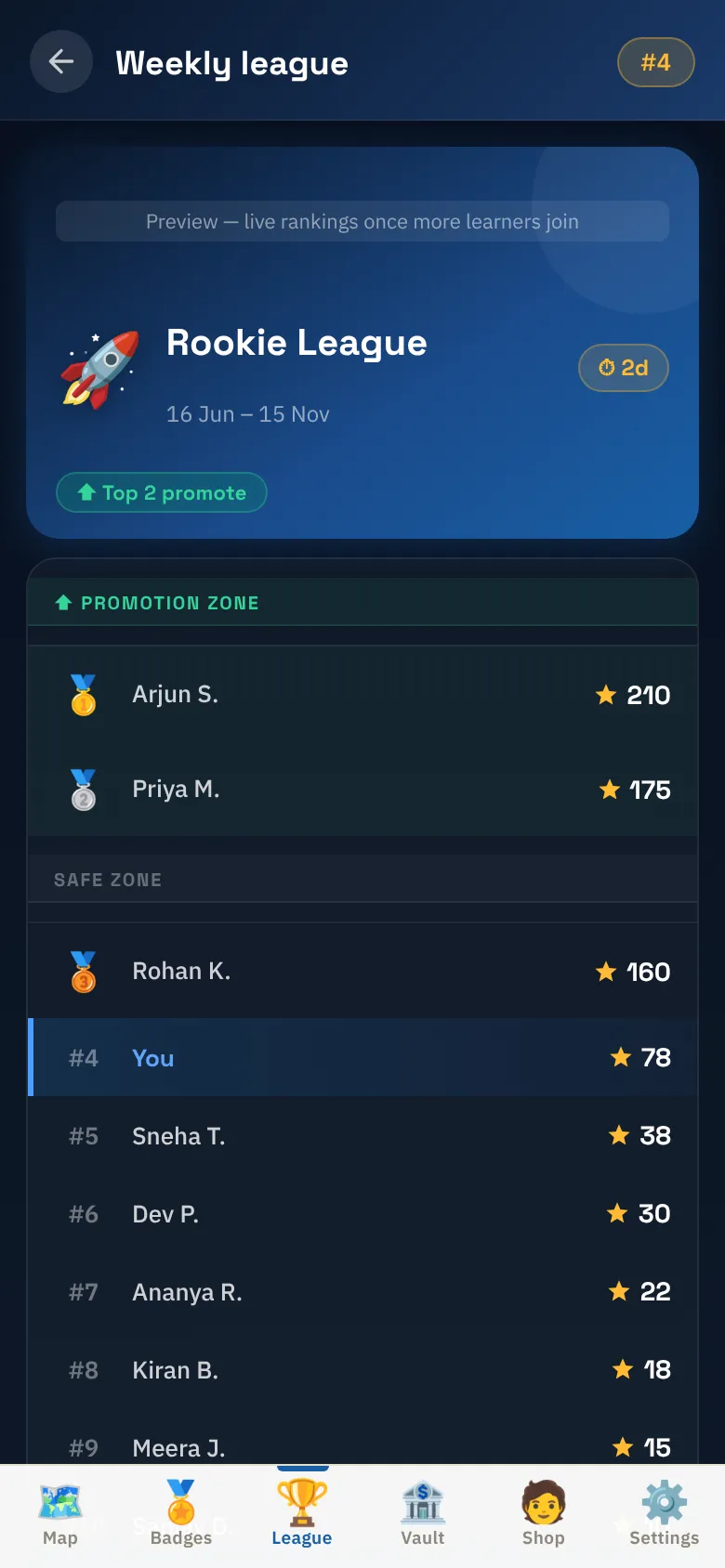
Weekly leagues
Leaderboards scoped to a learner’s own age tier. A 13-year-old is never ranked against an 18-year-old.
Tamper-proof assessments
Every module ends in a randomised assessment from a 50+ question bank, scored server-side.
Shareable certificates
Every module, and the full tier curriculum, ends in a real, LinkedIn-shareable certificate. Plus badges, ranks and a capstone certificate after a comprehensive final exam.
Resume anywhere
Every lesson remembers the exact screen a learner was on. Works as a native app and a full web app.
Teaching teens to protect what they build.
A full dedicated module, Money Shield, plus safety threads woven through borrowing, banking, payments and next-gen currency. Literacy is not complete if it only teaches growth and ignores risk.
- Emergency funds: why every plan needs a cushion, and how much is enough
- Insurance basics: what it actually protects against, demystified
- Fraud safety: spotting scams and phishing before they cost real money
- Net worth growth: tracking what is being built, not just what is spent
- Safe borrowing: recognising predatory debt before signing up for it
This isn’t a nice-to-have. Regulators call it a life skill.
India’s own financial regulators (RBI, SEBI, IRDAI and PFRDA) built the National Strategy for Financial Education around one idea: money habits are a life skill, not a topic to memorise for an exam.
A life skill, not a subject
RBI, SEBI, IRDAI and PFRDA all back one national strategy that treats money as behaviour to build, not facts to memorise. Pluto’s Vault takes that literally.
Confidence, not just facts
The UK’s national financial-wellbeing strategy calls out the emotional and social side of money (peer pressure, family conflict, FOMO) as core literacy. Pluto’s Money & Relationships module meets that bar.
A full course, not an add-on
A fast-growing majority of US states now require a dedicated personal-finance course for graduation. Pluto is built exactly that way: a complete, standalone course.
The lessons land at home.
We invest so much in their academic success — but money has quietly become invisible to them. When spending is just a tap, an OTP, a scan, wealth feels boundless. What worries me isn’t today’s pocket money. It’s whether they’ll know how to lead, build something of their own, resist a debt trap, and make real decisions when it’s actually their money on the line.
She started pricing her own candle business last month — and asked me for feedback on her margins. That’s when I knew the lessons had actually landed.
Start free. Pay once, when you’re ready.
Your teen can try the first 5 lessons free, right in the browser, with no card. If it clicks, you pay once, directly.
Try the first 5 lessons free
No card, no download. Open the link on a phone, tablet or laptop and begin.
Choose a plan when you’re ready
Parents pay once, directly. Current prices are always on the live pricing page.
Your teen owns it
Progress, badges and certificates belong to the learner from day one.
Good questions, straight answers.
Is it safe for my teenager?
Teen accounts sit under a parent’s email login, and explicit parental consent is captured for any child under 18. We collect only what a lesson needs. Pluto is built with India’s DPDP Act in mind.
Is this investment advice?
No. Pluto is a financial-education platform only. We do not provide investment, trading, tax, legal or advisory services, and nothing on this site or in the app is a recommendation to buy, sell or hold any asset.
What does the AI mentor do? Will it do the homework?
Sparky answers questions about the lesson your teen is on. A daily question quota keeps it a teaching tool rather than a shortcut, and it never gives personalised investment advice.
Can my teen try it before I pay?
Yes. The first 5 lessons are free, right in the browser, with no card needed.
How does pricing work?
Parents pay once, directly. We do not put prices on this page so they are never out of date: the live pricing page always has the current ones.
What if it is not right for us?
Read the Refund & Cancellation Policy, or message us on WhatsApp.
Which age is it for, and which device?
Ages 12–18, in three tiers matched to age. It works on Android, iPhone, iPad and Windows, installed straight from the browser. See how to install.
My teen is finishing school or college soon. Is there something for that?
Yes: Pluto Horizon is built for college students and first jobs.
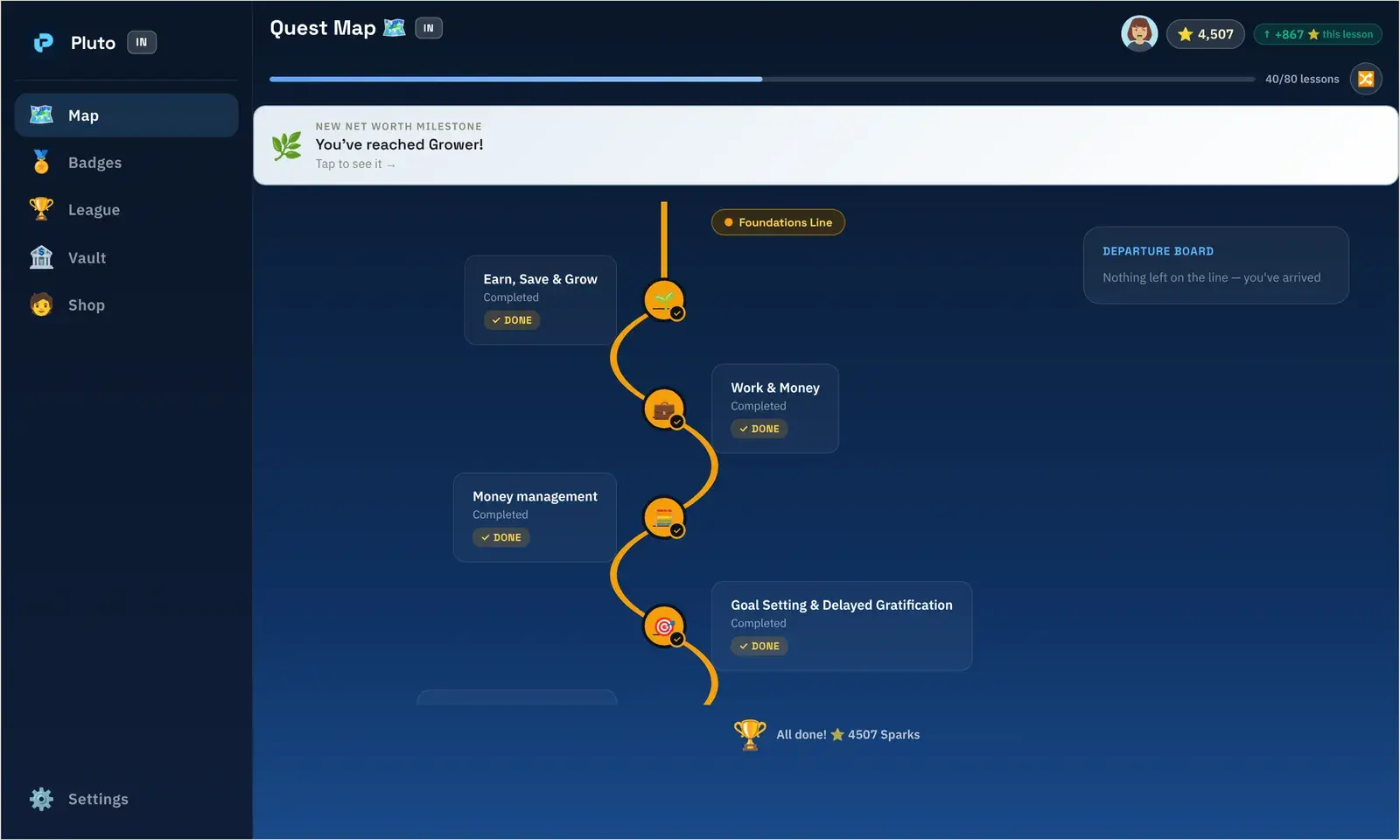
One account. Every screen.
Start on a phone, carry on from a tablet or laptop. Pluto for Teens runs the same everywhere, and progress follows your teen.
For parents & families
The full curriculum, the Vault, Sparky, pricing and what a subscription includes: everything a parent needs before saying yes. Print it, email it, or hand over a tablet.
Bringing Pluto to a school?
Cohort licensing, classroom rollout and the school brochure live on their own page, built for whoever is signing off the rollout.
Prefer to talk?
We typically respond within 2 business days.
A complete financial education, built for one generation.
Twenty modules across three age-tiered flight plans. A real practice Vault. An AI mentor. Certificates that mean something.
Built with India’s DPDP Act in mind: teen accounts sit under a parent’s email login, with explicit parental consent captured for any child under 18.